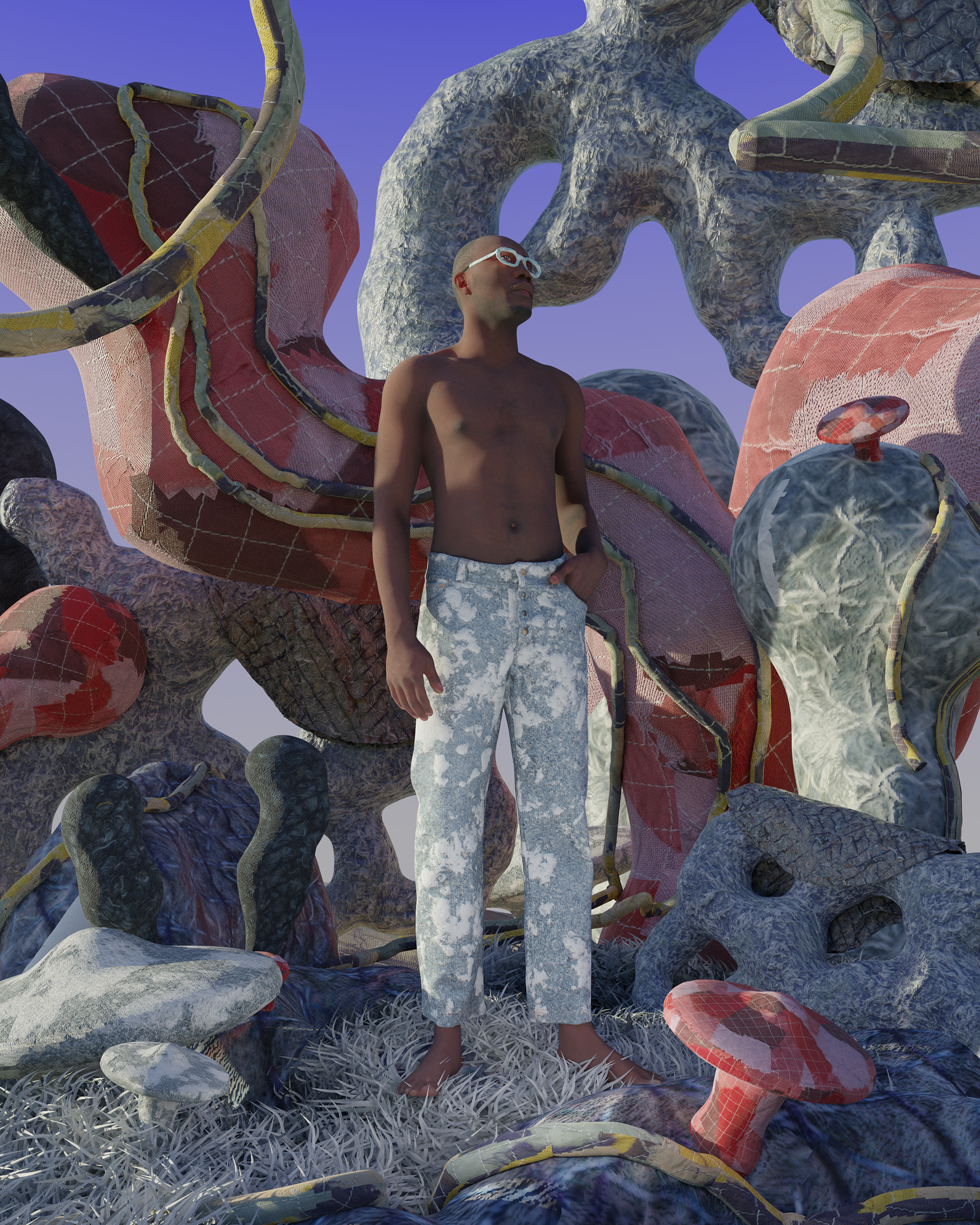
New Blue – A new circular jeans material
With the rise of fast fashion, denim has transitioned from a hardwearing, durable workwear fabric into a staple of the contemporary wardrobe and we are left with vast streams of waste without the infrastructure to absorb them.
As it is today, a worn-out pair of jeans is treated as a waste product, from which the useful materials can be extracted and then repurposed as, for example, building insulation. This project seeks to change this methodology by instead finding a way of reincarnating the jeans as a renewed version of themselves.
New Blue promotes a different material cycle, which manifests itself in the novel production sequences as well as its final outcome.
The traditional end product is now envisaged as one stage within a continuous, circular succession of decomposing and recomposing. By adopting this approach, the aesthetic of the jeans – from the texture of the reborn denim, and the design of the overstitching to the cut of the pattern – can also evolve with time, responding to trends and ensuring the reincarnated product is always relevant and personal.
A unique process
1. To begin the process, discarded jeans - serving as a raw material - are cut into small fibres and then bonded to form a fleece.
2. The New Blue project offers a novel way to form defined areas on a fabric roll. Digitally-aided industrial embroidery is applied to the fleece not only to create a stable fabric but also to generate the cut-patterns needed for the final piece of clothing, thus rationalising the entire production process from fibres to garment.
3. The embroidered areas of the non-woven cloth remain intact when exposed to water, whereas the non-embroidered parts of the fleece disintegrate. These loose denim fibres can be reused as raw material, while the embroidered parts remain stable and can be sewn together without further cutting, establishing a circular zero waste production method.
New Blue Industry - Indigo
New Blue Industry - Logwood
New Blue Craft - Pink Black
New Blue Craft - Vintage
During the course of the project, two distinct routes have been explored, each with their own unique qualities: an industrially produced recycled jeans fibre non-woven fabric, and a self-produced, ‘’handcrafted’’ non-woven fabric. The industrially produced non-woven shows a homogenous, uniform surface, whereas the crafted fleece appears irregular, rough and textured, giving room for individual expression.
With an absolute minimum usage of water, chemicals and dye, new high quality expressions of the New Blue material, industry and craft have been established. This by the courtesy of the research grant Re-FREAM under the European Commission’s Horizon 2020 research and innovation programme. The various new colours that habe been added to the palette of New Blue: Logwood (natural dye), Indigo, Pink Black and Vintage.
A New Kind of Blue
Is a design studio building new circular pathways in fashion and textile production.
A New Kind of Blue is a Berlin based design project looking for locally embedded solutions to global challenges with the starting point in circular economy. The project is founded by textile and fashion designer Tim van der Loo. He strives towards rethinking the notion and aesthetics of recycled materials and creating truly circular product life cycles.
With the project New Blue, Tim van der Loo has received significant acknowledgment. In 2020 the project was awarded with the German Federal Ecodesign Award in the category of young talent. It has moreover been mentioned in various trend reports like WGSN, Noroo and Heimtextile and published on the new platforms DW, Creative City Berlin and Tagesspiegel. In July 2021, the project was exhibited in the All Good(s) programme from the Embassy of the Netherlands in Berlin at Martin Gropius Bau in the scope of the royal visit of the King and Queen of the Netherlands.
Credits
This project would not have been possible without my business partner and friend, Sandra Nicoline Nielsen.
Models: Chantelle Gallo, Thomas Durrant & Tim van der Loo
3D animation & direction: Misha Gurovich
This project received funding from Re-FREAM (European Union's Horizon 2020 research and innovation programme) in 2021, DesignFarmBerlin (Europäischer Sozialfonds) in 2020 and the DAAD Abschluss Förderung in 2019.
This project was initiated at weißensee academy of art Berlin at the Textile and Surface design department as M.A. graduation project under supervision of Prof. Dr. Zane Berzina, Prof. Dr. Lucy Norris and Dipl.-Des. (academic assistant) Christian Frank Müller.
This project was generously supported by charity organisation Textilhafen.